
Australian minister’s address
The Hon. Jason Clare, MP., Australian Minister for Defence Materiel addressed the Australian Defence Magazine Conference at the Hyatt Hotel, Canberra, on 16th February.
Conference had the theme, ‘A Big Year Ahead’. Inter alia the Minister said, ‘In the Air Force we will take delivery of the final nine Boeing F18 Super Hornets; and work towards Initial Operating Capability on Wedgetail, the Airborne Early Warning & Control [AEW&C] aircraft.
IFALPA Vision Statement
On 8th February the International Federation of Airline Pilots Associations (IFALPA), the global voice of airline pilots, issued its Vision Statement entitled ‘The Future of Air Navigation’.
This document considers ICAO’s role and the role of governments; the roles of the air navigation service providers and that of the aviation industry.
Italian Coast Guard surveillance
It was reported on 11th February that members of the Italian Coast Guard have gathered at ESA to attend an advanced training workshop on the latest space technologies for maritime monitoring and surveillance and to identify future opportunities for collaboration. ESA and the Italian Coast Guard have been collaborating for nearly 20 years on satellite-based services for vessel and oil pollution surveillance in the Mediterranean as well as in international waters.
ECDIS training module
Electronic navigation specialist MARIS and training company Seagull have reached an agreement to develop a comprehensive product-specific computer-based training ECDIS (Electronic Chart Display and Information System) module, it was reported at the end of January.
In order to replace paper charts, ECDIS systems must fulfil considerable technical requirements laid down in the IMO ECDIS Performance Standards. New requirements for competence and training have been amended in the STCW convention. As well as including approved ECDIS simulator training, the standard opens up wider delivery sources of training, including onboard instruction.
NTSB investigation in Ireland
At about 0945 (GMT), on 10th February a Swearingen SA-227 Metroliner (Spanish registration EC-ITP), operated by Flightline/Manx2 Air as flight 7100 from Belfast, Northern Ireland, crashed after attempting a landing at Cork Airport, Cork, Ireland. Twelve people were aboard the aircraft, and there are reports of both fatalities and survivors.
The National Transportation Safety Board reported later that day that it was sending three investigators to assist the Government of Ireland as it investigates the crash.
MSC’s USNS Henson’s eight month deployment
It was announced from Naples in mid-January that the Military Sealift Command’s oceanographic survey ship USNS Henson completed her eight-month deployment to the US 6th Fleet area of responsibility. She spent 163 days on station and conducted survey operations in the Norwegian Sea and the Gulf of Guinea. The ship, its crew of civilian mariners, and an embarked team of 29 oceanographers, historians, underwater archaeologists and researchers, also participated in the most recent search off the coast of England for the Revolutionary warship Bonhomme Richard, captained by John Paul Jones when it was lost at sea in 1799.
Exercises Freedom Banner and Cobra Gold
At the end of January three Military Sealift Command ships discharged hundreds of pieces of US Marine Corps equipment, containerized supplies and personnel in support of exercises Freedom Banner and Cobra Gold at Chuk Samet, Thailand.
Freedom Banner 2011 brought together multiple commands to offload Maritime Prepositioning Force ships USNSs 1st Lt Jack Lummus and 1st Lt Harry L Martin while both ships were anchored three miles offshore.
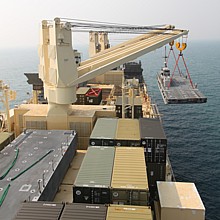
A powered lighterage module is offloaded from the Maritime Prepositioning Force ship USNS 1st Lt Jack Lummus more than three miles off the coast of Chuk Samet, Thailand, on 20th January, while conducting Exercise Freedom Banner 2011. The module is powered by a jet propulsion system and attaches to two other modules which are then used to ferry cargo ashore. The equipment offloaded from Lummus will be deployed by Marines for their portion of Exercise Cobra Gold 2011, scheduled to be held in early February.
(US Navy photo by Ed Baxter, SEALOGFE Public Affairs.)
NTSB and an operational error
The National Transportation Safety Board has been investigating an operational error that occurred near New York City in January.
NTSB was notified of a Traffic Collision and Alerting System (TCAS) resolution advisory that occurred due to a near midair collision involving American Airlines flight 951 on 20th January this year at about 2230 Eastern Standard Time.
NTSB recommendation to USCG
On 4th February the NTSB reported that it had made the following new safety recommendations to the US Coast Guard.
Franco-Spanish rail link
A new railway section linking the Spanish and French networks opened at the end
of January today thanks to about € 70 million in European Union funding.
The 44.4 km Perpignan-Figueras railway section is suitable for both high-speed rail and freight transport and is expected to significantly cut journey times.
Tangier VTS
At the end of last year HM King Mohammed VI of Morocco inaugurated the Tangier maritime traffic control centre (MTCS) established at a costs of Dirhams 50 million ($ 6 million). The new installation, provided by SOFRELOG, will contribute to improving the maritime traffic efficiency and protection of the
environment in the Gibraltar Strait.
Israel signs co-operation agreement
On 31st January it was reported by ESA that Israel had signed a Coperation Agreement, the objective of which is to allow Israel and ESA to create the framework for more-intensive co-operation in ESA projects in the future.
Pirate defence system launched
United Kingdom-based, marine security specialist company, Photonic Security Systems (PSS) launch a new proactive pirate defence system, the LDS100, earlier this month.
The LDS100 acts in what is said to be a non-lethal and humane manner and is based on a proactive method to prevent pirates from approaching a ship. The system works by sending a ten metre wide multi-band laser light beam, up to a distance of one kilometre to dazzle potential intruders and disable them from locating and boarding the ship.
New Deputy Master and Executive Chairman for Trinity House
Captain Ian McNaught has been appointed Deputy Master of the Corporation of Trinity House and Executive Chairman of the Lighthouse Authority. He succeeds
Rear-Admiral Sir Jeremy de Halpert who will stand down towards the end of the
year.
Maersk and the UN World Food Programme
The A.P. Moller – Maersk Group announced on 27th January that it had joined a team of international companies, designated as a disaster relief support network under the United Nations World Food Programme (WFP). The Logistics Emergency Teams (LETs) consist of four of the world’s leading logistics and transport companies and supports the WFP and the humanitarian community during disaster relief efforts by providing access to a global network of transportation and logistics expertise.
Official opening of the World Class Aviation Academy
On 17th January Terma B.V. in The Netherlands and the World Class Aviation Academy (WCAA) signed an agreement of co-operation covering training and life-cycle support for aircraft survivability equipment and other airborne systems in use by air forces and airlines all over the world.
ATSB Report: Main landing gear failure
Following landing at Melbourne Aerodrome from Adelaide on 20th October 2009, the crew of a Boeing 737-8FE aircraft, registration VHVUI, reported that the aircraft was difficult to taxi, requiring more power and steering input than usual. A subsequent visual inspection revealed the number-4 wheel to be oriented at an angle with respect to the axle and, following disassembly, it was discovered that the inner wheel hub and bearing mount had broken away from the wheel assembly.
CANSO announces UAE declaration
CANSO, the Global Voice of ATM, issued on 20th January its UAE Declaration, a statement announcing plans to undertake a Joint Middle East Airspace Study and develop a co-ordinated approach to optimising the region’s airspace structure.
The declaration was developed by the Association’s Middle East CEO Co-ordination Committee (MEC3) and endorsed at a High Level Meeting on 17th January. It recognises the critical role aviation plays in the economic prosperity of the Middle East and beyond, while drawing attention to the importance of addressing air transport capacity challenges.
Take-off performance calculation and entry errors: A global perspective
There have been numerous take-off accidents worldwide that were the result of a simple data calculation or entry error by the flight crew. This report documents 20 international and 11 Australian accidents and incidents (occurrences) identified between 1st January 1989 and 30th June 2009 where the calculation and entry of erroneous take-off performance parameters, such as aircraft weights and ‘V speeds’ were involved. Importantly, it provides an analysis of the safety factors that contributed to the international occurrences and suggests ways to prevent and detect such errors.
The 5th GNSS Vulnerabilities and Solutions Conference
The Royal Institute of Navigation, London, and the Institute of Engineering Surveying and Space Geodesy, University of Nottingham, are organising the 5th GNSS Vulnerabilities and Solutions 2011 Conference to be held from 23rd to 25th May 2011 in Baška, Krk Island, Croatia.
Rail Accident Investigation
At the end of January the British Rail Accident Investigation Branch (RAIB) released its report into a near miss involving a freight train and two passenger trains at Carstairs in Scotland on 22nd December 2009.
The sole purpose of RAIB investigations is to prevent future accidents and incidents and improve railway safety. The RAIB does not establish blame, liability or carry out prosecutions.
The 7th Annual Arctic Shipping Summit
To take advantage of the increasing activities in the Arctic, the Arctic Shipping
Summit in 2011 will feature leading experts from a diverse background in discussing and analysing these critical developments and practical challenges. The event welcomes Arctic professionals in knowledge-sharing, networking and analysis of the challenges and solutions for shipping in ice and cold climates.
European Space Agency and Galileo
By the end of January Galileo’s first satellite was undergoing testing at ESA’s technical centre in The Netherlands, checking its readiness to be launched into orbit. This marks a significant step for Europe’s Galileo satellite navigation constellation.
The first part of Europe’s global satellite navigation system is due to be
launched over the next two years ? a total of four Galileo In-Orbit Validation (IOV) satellites. The following four years to 2015 will see Galileo brought up to its first operational configuration of 18 satellites in medium Earth orbit.
Completion of first phase of a two phase GPS
It was announced from Schriever Air Force Base, Colorado, on 19th January that
the 50th Space Wing had completed Phase One of a two phase Global Positioning
System constellation expansion known as ‘Expandable 24’. When fully complete,
this expansion will increase global GPS coverage and provide civil, military and commercial GPS users with more robust satellite availability and a higher
probability of signal acquisition in terrain challenged environments.
The GPS constellation consists of 24 operational slots positioned within six equally-spaced orbital planes surrounding the earth. This plane/slot scheme and enhanced satellite placement ensure GPS users receive the most accurate
navigation data at any time, at any place around the world.
HMAS Melbourne’s final anti-piracy act
On her final day assigned to operations in the Middle East, Royal Australian Navy frigate HMAS Melbourne continued her important work of securing vital sea lanes of communication. Just hours before handing over the maritime security task in the Middle East Area of Operations to HMAS Stuart, HMAS Melbourne was called upon to assist a merchant vessel in distress.