
December 7, International Civil Aviation Day – The ITF view

We should be looking ahead, this International Civil Aviation Day, to the challenges of economic recovery and climate change. Instead, we’re still gripped by the devastating impact that Covid-19 continues to have of aviation workers and the industry worldwide. This was the message on the day, 7 December, from the International Transport Workers’ Federation (ITF).
ITF’s message continued to inform that governments in some rich countries have put their own vaccine programmes ahead of tackling the pandemic as a global emergency, and sadly the rise of new, dangerous variants is a setback to the industry’s already fragile recovery.
Workers in aviation are paying the price for this. The knee-jerk reaction to the Omicron variant and tightening of travel restrictions begin a new wave of devastation, hitting an industry already ravaged by the pandemic.
ICAO and UNWTO Joint Statement for Aviation Day

For the first time since International Civil Aviation Day was established, in 1994, ICAO commemorated 7 December this year with a special Joint Statement with the UN World Tourism Organization (UNWTO) calling for accelerated global efforts to reconnect the world. This was reported by ICAO from Montreal on the day.
With global connectivity recovery on course, both UN bodies called for intensified efforts towards vaccine equity and stressed that restrictions on travel due to new variants of Covid-19 must only be used ‘as a very last resort,’ noting they are ‘discriminatory, ineffective and against the guidance of the World Health Organization.’
Two new satellites mark further enlargement of Galileo

On 5 December it was reported by the European Space Agency (ESA) that Europe’s largest satellite constellation had grown even bigger, following the launch of two more Galileo navigation satellites by Soyuz launcher from Europe’s Spaceport in French Guiana on that day.
Galileo satellites 27 and 28 add to an existing 26-satellite constellation in orbit, providing what is claimed to be the world’s most precise satnav positioning to more than 2.3 billion users around the globe.
ESA Director of Navigation Paul Verhoef commented: ‘Today’s lift-off marks the eleventh Galileo launch of operational satellites in ten years: a decade of hard work by Europe’s Galileo partners and European industry, over the course of which Galileo was first established as a working system then began Initial Services in 2016. With these satellites we are now increasing the robustness of the constellation so that a higher level of service guarantees can be provided.’
The world’s fastest all-electric vehicle Spirit of Innovation stakes claim
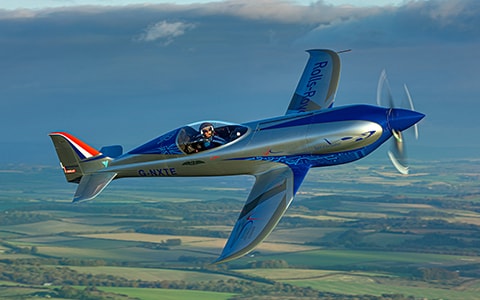
Rolls-Royce has a rich history of air speed record attempts and breaking records, dating back to the Schneider Trophy competitions of the early 1930s.
The speed achieved by test pilot and Rolls-Royce Director of Flight Operations Phill O’Dell in the Spirit of Innovation was more than 213.04 km/h (132 mph) faster than the previous record set by the Siemens eAircraft in 2017. Never in the history of the FAI record attempts has there been such a significant increase in speed over such a short time, highlighting the rapid pace at which electrification of aerospace is advancing.
Towards the end of November Rolls-Royce indicated that the Spirit of Innovation is part of the ACCEL or Accelerating the Electrification of Flight project. Half of the project’s funding is provided by the Aerospace Technology Institute (ATI), in partnership with the Department for Business, Energy & Industrial Strategy and Innovate UK.
Spirit of Innovation, the aircraft, was propelled on its recent record breaking runs by a 400kW (500+hp) electric powertrain and the most power-dense propulsion battery pack ever assembled in aerospace. Rolls-Royce worked in partnership with aviation energy storage specialist Electroflight and automotive powertrain supplier YASA.
SEA-KIT uncrewed surface vessel trials
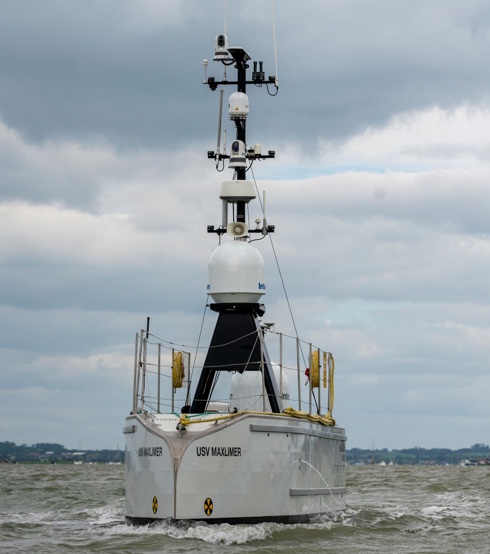
Inmarsat announced at the end of November that it had installed a new connectivity capability using virtual networks that will establish higher standards for over-the-horizon uncrewed vessel control.
The installation connects the SEA-KIT International uncrewed surface vessel (USV) Maxlimer to the best available network at all times by switching as necessary between Fleet LTE, Global Xpress (GX) and FleetBroadband satellite services when out of range.
It is understood that the combination will set new standards in continuous connectivity to serve a broader range of USV situations and support the next phase of SEA-KIT technology trials, which started in September off the coast of Plymouth, (UK, South West).
HMS Queen Elizabeth cross-decks with the Italian Navy
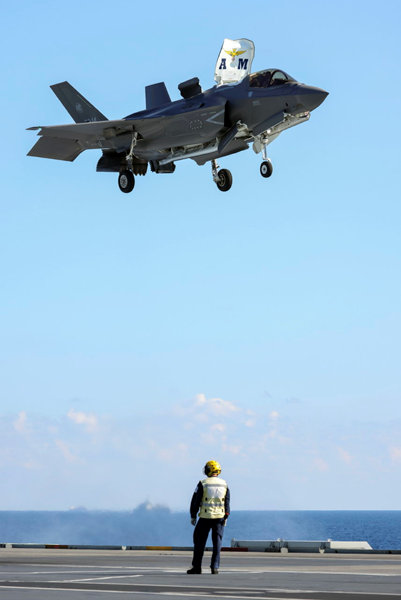

History was made on 22 November when HMS Queen Elizabeth exchanged F- 35B jets from the US Marine Corps VFMA-211 squadron with the Italian Navy and Italian Air Force.
The VFMA-211 US Marine Corps jets departed HMS Queen Elizabeth and landed on the Italian carrier Cavour. Two F35B Lightning jets from the Italian Navy and Italian Air Force landed, refuelled, and relaunched from Queen Elizabeth.
Italy is the third nation that has landed jets on the British carrier. On completion of the refuelling Queen Elizabeth launched an Italian Navy F-35, Italian Air Force F-35, US Marine Corps F-35 and finally an F-35B from 617 Squadron, Royal Air Force. The jets then operated in the skies above the two carriers developing their interoperability and mutual understanding of procedures.
RAF and synthetic fuel flight

powered by 100% synthetic fuel – UK MoD © Crown copyright 2021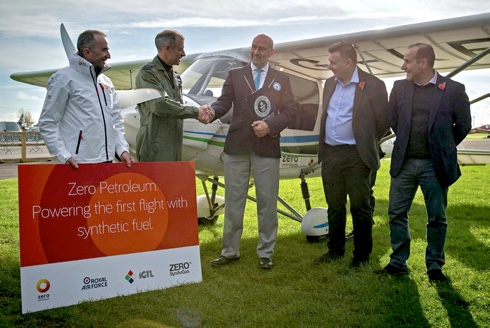
The RAF and Zero Petroleum have won a Guinness World Record for the world’s first successful flight using only synthetic fuel.
In a world-first, an Ikarus C42 microlight aircraft flown by Group Captain Peter Hackett, completed a short flight powered by synthetic gasoline at Kemble Airfield, Cotswold Airport, Cirencester, Gloucestershire, England, earlier this month.
Zero Petroleum’s synthetic UL91 fuel is manufactured by extracting hydrogen from water and carbon from atmospheric carbon dioxide. Using energy generated from sources such as wind or solar, these are combined to create the synthetic fuel.
This innovation is part of the RAF’s Project MARTIN and has the potential to save 80-90% of carbon per flight, supporting the RAF’s vision that synthetic fuels will have a major role in powering the fast jets of the future.
The future of a resilient, trustworthy and ubiquitous Time Transfer

On Wednesday, November 10, 2021, GMV GmbH teaming up with the National Metrology Institute of Germany (PTB) presented the results of the project ‘RESILIENT, TRUSTWORTHY, UBIQUITOUS TIME TRANSFER’ which were achieved through the support of the NAVISP program. Almost 70 people from industry and research attended the final presentation, which shows the great public interest in the project.
As part of NAVISP Element 1, which aims to develop innovative concepts, techniques, technologies, and systems related to the PNT sector along the entire value chain, GMV GmbH’s main objective was to develop innovative and complementary methods of time transfer, focusing on the use of non-GNSS technologies to address common vulnerabilities of all GNSS-based time transfer techniques, such as susceptibility to spoofing, jamming, and signal blockage (indoors).
Telespazio UK appoints new Head of Navigation

Martin Bransby joined Telespazio UK in August as the Head of Navigation, with responsibility for delivering activities focussed on robust, resilient and alternative (to GNSS) Positioning, Navigation and Timing (PNT) services.
He was previously with the General Lighthouse Authorities of the United Kingdom and Ireland where he was Head of Research and Development for sixteen years.
According to Telespazio he joined at a time the company is strengthening and developing its Navigation and PNT portfolio, and his domain experience in maritime brings an additional dimension to Telespazio’s Navigation and PNT business.
General Lighthouse Authorities appoint new Head of Ramp;&D
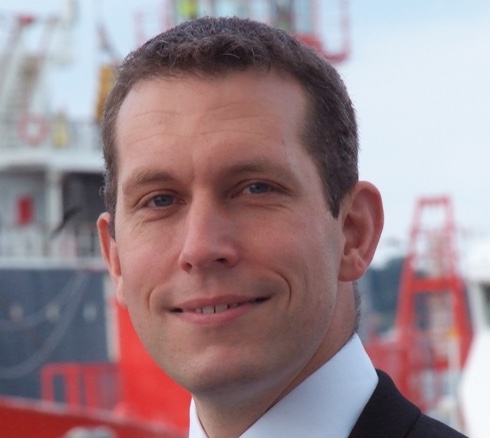
We learn that the General Lighthouse Authorities of the United Kingdom and Ireland (GLA) have named Dr Alan Grant as the Head of its Research and Development team. He assumed his new role on 1 November.
As part of his duties Dr Grant heads the GLA’s research and development programme, considering existing and future maritime requirements and operational strategy.
Dr Grant joined the GLAs in 2003 and has worked on a variety of systems during his time with GRAD. He led a series of successful GPS jamming trials and the development of the multi-system radionavigation receiver performance standards, from initial concept through to international recognition at the IMO. He continues to support resilient positioning, navigation and timing (PNT) in maritime navigation at both technical and strategic levels.
Navigation 2021 IS happening!

There are many uncertainties in the world at the moment but Navigation 2021 is not one of them.
The Navigation 2021 Conference will be going ahead as a hybrid event from 16-18 November. The full conference will be taking place online on our immersive conference platform, and for those who are able to join in person please join the conference in Edinburgh (including two evening socials).
The conference platform is now live – register now to join the experience.
Polar vessels meet at Harwich International
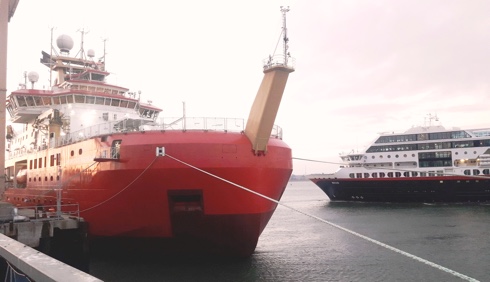
On 20 October Hutchison Ports Harwich International welcomed the first call by mv Maud, a polar cruise vessel operated by Norwegian Hurtigruten Group. The ship is named after one of the most famous polar vessels, the original Maud took explorer Roald Amundsen on his second expedition to the Arctic in 1917.
Returning from a 14-night cruise of Norway during which time the vessel crossed the Arctic Circle, Maud was in Harwich International port at the same time as the British Antarctic Survey‘s new vessel, RRS Sir David Attenborough.
Sir David Attenborough was due to remain at Harwich then sail for London to become the centre of the British Antarctic Survey’s showcase of polar environmental science, engineering and technology, to coincide with the UN COP26 climate talks in Glasgow from 1 November.
29th Saint Petersburg International Conference on Integrated Navigation Systems
The 29th Saint Petersburg International Conference on Integrated Navigation Systems will be held by the State Research Center of the Russian Federation – Concern Central Scientific and Research Institute Elektropribor, JSC (St. Petersburg, Russia) on 30 May – 1 June 2022.
This annual Conference has become a traditional event for scientists and engineers from all over the world involved in navigation and motion control to share the results of their investigations and discuss prospects for the future.
Galileo Control Segment upgrade ready for next launch
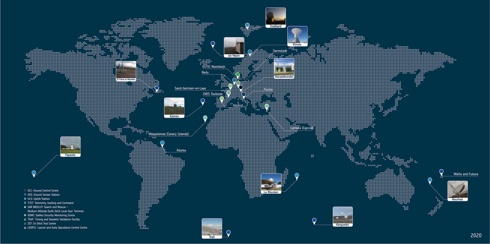
A significant first for next month’s 11th Galileo launch: thanks to an upgrade of the world-spanning Galileo Control Segment, this will be the first launch where the satellites’ first steps into space will be overseen from an existing Galileo Control Centre, rather than requiring an external mission control site.
For all Galileo launches up until this one, the satellites’ post-liftoff ‘Launch and Early Operations Phase’ (LEOP) have been overseen from either ESA’s ESOC control centre in Darmstadt, Germany, or French space agency CNES’s site in Toulouse, France.
As well as increasing overall reliability and cybersecurity, this new upgrade also opens the way to significant expansion of the Galileo constellation, which at 26 satellites already equals Europe’s largest satellite constellation. This updated Galileo Control Segment (GCS) is designed to enable oversight of up to 38 satellites, harnessing state-of-the-art technology using the latest solutions on the market.
2022 Israel Navigation Conference and Exhibition – third announcement

The Navigation Workshop is a biennial event organized and sponsored by the Israel Association for Automatic Control (IAAC). For those not familiar with the association, the IAAC is a non-profit organization congregating a large number of members from Academy and Industry interested in the broad areas of Control and System Theory.
Check the webpage for further details and the opportunity to subscribe to the IAAC mailing list.
Following the huge success of previous events, the 2022 edition has been scheduled for 31 January at the Daniel Hotel, Herzliya. The workshop is a one day event dedicated to technical talks that range from fundamental research, to applications, to field test results.
Navigation 2021 / ENC2021 will take place from 15 to 18 November

Professsor Terry Moore, Conference Chair has been pleased to provide the following update: ‘As Chair of Navigation 2021, I am delighted to confirm that this major navigation conference will include an in-person element: we will meet at the Edinburgh International Conference Centre from 15-18 November 2021. Delegates may also join virtually.
Navigation 2021 is about collaboration and understanding across science, technology and practice – including applications, animal navigation, cognition and human factors. This is shaping up to be a very significant event.’
ION journal to be open access
In the US, the Institute of Navigation announced at the end of September that its journal, NAVIGATION, will be Open Access (OA) beginning on 1 January 2022.
NAVIGATION is one the leading peer-reviewed and indexed scientific journal publishing articles on all areas related to the art and science of Positioning, Navigation, and Timing (PNT).
Lisa Beaty, the journal’s managing editor and executive director of ION commented: ‘Moving NAVIGATION to an Open Access domain is critical to supporting ION’s mission of advancing Positioning, Navigation, and Timing, and will speed the delivery of timely PNT research, without the restrictions of paywalls or price barriers, to a worldwide audience. We want all scientists and engineers to be able to collaborate, analyse, and build upon each other’s work for society’s common good.’
Dr Mark Psiaki receives the ION Kepler Award
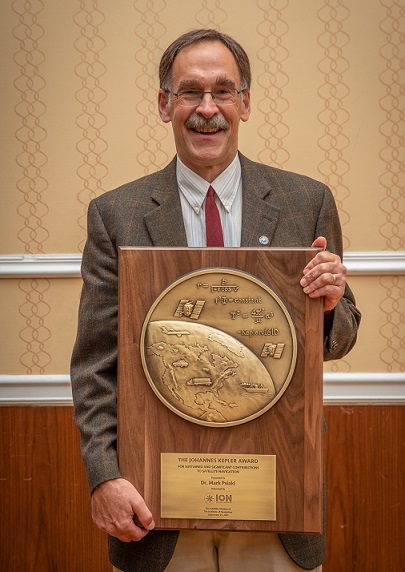
The Institute of Navigation presented Dr Mark Psiaki with the prestigious Johannes Kepler Award during the ION GNSS+ 2021 Conference on 24 September.
Dr Psiaki was recognized for setting a standard of rigor, clarity, and thoroughness in addressing key estimation and signal processing problems in PNT.
He originated the technique of bit-wise parallel RF signal processing for use in general-purpose processors. This enabler of software-defined GNSS led to the first space deployment of a fully software-defined GNSS receiver on a general- purpose DSP and to the widespread adoption of software-defined GNSS across the aerospace industry.
Additionally, Dr Psiaki’s real-time software radio expertise enabled the development of a spoofer cultivated in his research group. Dr Psiaki subsequently led the development of spoofing detection algorithms based on cross-correlation of unknown P(Y) codes and based on direction-of-arrival sensing.
Dr Lakshay Narula receives ION’s Parkinson Award
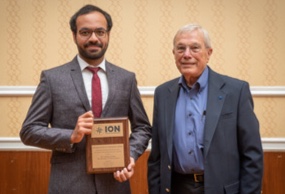
The (US) Institute of Navigation presented Dr Lakshay Narula with its prestigious Bradford W Parkinson Award during the ION GNSS+ 2021 Conference on 24 September 2021.
Dr Narula was recognized for his thesis, Towards Secure & Robust PNT for Automated Systems.
The Bradford W Parkinson Award is awarded annually to an outstanding graduate student in the field of Global Navigation Satellite Systems (GNSS).
The award, which honours Dr Parkinson for his leadership in establishing both the US Global Positioning System and the Satellite Division of the Institute of Navigation, includes a personalized plaque and a $2,500 honorarium.
IAAC Missile Guidance workshop

Leonid Mirkin has written to all IAAC list subscribers by way of reminder that the early registration deadline (10 October) for the IAAC workshop ‘Missile Guidance’ is approaching. The workshop will be held on 18 October and its programme and the registration form are parts of the workshop invitation.
More details can be found in its book of abstracts available here.
He advises that visitors take into consideration that the workshop will require a valid Green Pass to enter.
Admiral Sir Tony Radakin KCB ADC to be Chief of the UK Defence Staff
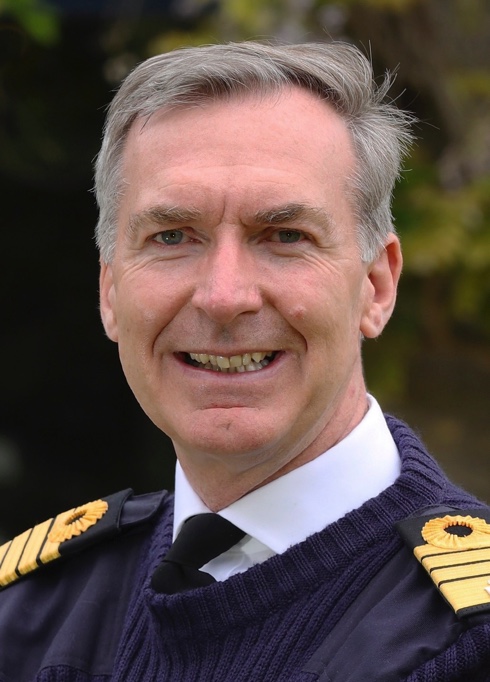
It was announced on 7 October that HM the Queen had approved the appointment of Admiral Sir Tony Radakin KCB ADC to take over from General Sir Nicholas Carter GCB CBE DSO ADC Gen as the next Chief of the Defence Staff.
The Chief of the Defence Staff is the professional head of the Armed Forces and principal military adviser to the Secretary of State for Defence and the government. The role reports to the Secretary of State and the Prime Minister.
The Navigation Flashlight 2021-2

From our Austrian member institute, the Österreichischer Verein für Navigation, we have received word of the latest issue of their regular publication, The Navigation Flashlight. It is published three times a year, currently in its twenty first year of publication and it is in German.
Reminder: Besonders wollte ich auch nochmal auf die AHORN 2021 aufmerksam machen, die am 1. und 2. Dezember in Schladming stattfindet. Die Deadline für Einreichungen ist der 11. Oktober 2021. Weitere Infos dazu finden Sie im Flashlight.
USCG and JCG cooperation
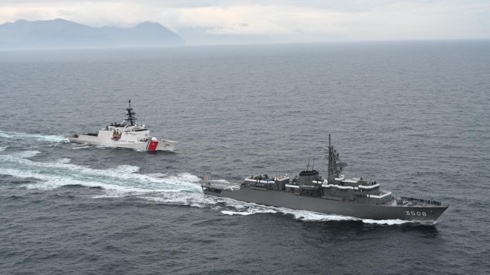
Over the past year, the United States and Japan have increasingly strengthened their relationship in the maritime domain through the shared mission set of the Japanese Maritime Self-Defense Force and the US Coast Guard.
The Kimball and Kashima crews operated alongside one another in the Aleutian Island chain to exchange visual communications, followed by honours, as their respective crews lined their ship’s rails for a uniform salute. This display of maritime cooperation and mutual respect emphasizes both the United States’ and Japan’s continued commitment to one another and to partnership at sea.
Captain Thomas D’Arcy, CO of Kimball commented: ‘The Kimball crew welcomed the opportunity to meet the Kashima and conduct a professional exercise at sea.
Seeing the crews aboard the Kimball and the Kashima line the rails for the passing of honours illustrates the spirit of collaboration between the US Coast Guard and Japan’s maritime forces. The exercise, movements and communications between our vessels were expertly executed and the salutes exchanged exemplify the strength of our relationship with Japan as a key partner.’
US Coast Guard study – Evaluation of Pacific coastal waterway use
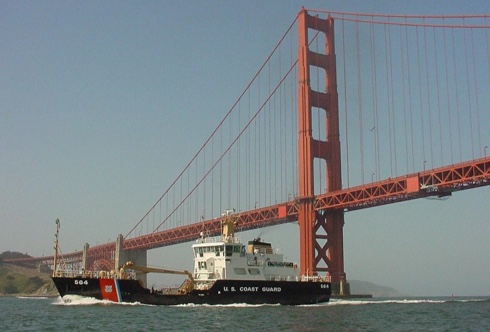
On 24 September from San Francisco, the USCG 11th District (Pacific Southwest) announced that it had requested public participation during the Pacific Coast Port Access Route Study (PAC-PARS).
Federal register notices for the PAC-PARS have been opened for comment. Comments and related materials must be received on or before 25 January 2022.
It is understood that the PAC-PARS will evaluate the use of coastal waterways by collecting vessel tracking data, environmental data, existing and planned offshore development/infrastructure, historical marine incident data, and public comment.
We learn that this is the first comprehensive evaluation of all vessel traffic patterns that use the Pacific Coast waterway along the coast of California, Oregon, and Washington. The main goal of the PAC-PARS is to evaluate historic and future waterway use to determine navigational risk.
North Pacific Coast Guard Forum Summit

The commander of US Coast Guard Pacific Area, an Alameda, California-based unit that oversees US Coast Guard activities from the US western states to Asia and from the Arctic to Antarctica, hosted an annual forum summit with coast guard counterparts from five countries on 14, 15 and 16 September.
During this year’s North Pacific Coast Guard Forum Summit, forum members gathered virtually over the course of three days to discuss topics such as challenges in the North Pacific, the need for coordinated responses to those challenges, and Japan Coast Guard’s best practices and lessons learned while supporting the Tokyo Olympics.
Vice Admiral Michael F McAllister commented: ‘The forum presents us the invaluable opportunity to communicate best practices, learn from each other and share information on myriad topics including search and rescue, counterdrug, pollution response, illicit trafficking, and illegal, unreported and unregulated fishing, among others.’