
IAIN Technical Committee Issues Circular Letter Seeking Input on Draft Terminology for Autonomous Ship Navigation
IAIN Technical Committee Issues Circular Letter to Solicit Industry Comments on Draft Technical Terms for Maritime Autonomous Navigation.
The IAIN Technical Committee previously invited all member institutes to submit comments and proposals on the draft of IAIN’s first technical document. To facilitate broader recognition of the document upon publication, the Committee has today released a circular letter via this website to call for feedback on the draft from interested industry organisations and experts.
The circular letter outlines progress in developing the first IAIN technical document which will be submitted to the Technical Committee for formal deliberation in October this year.
Stakeholders may download and review the circular letter and its annex, Terminology for Ship Autonomous Navigation Technology–Draft, July 2026 via the official IAIN website: https://iainav.org/category/news/.
The IAIN Technical Committee encourages all member institutes, interested industry organisations and experts to provide written comments and recommendations on the draft. All constructive feedback will be fully considered in the Committee’s subsequent work. Comments and suggestions concerning the draft may be sent directly to the E-mail: president@iainav.org.
IAIN Officers Meeting Held in Vienna
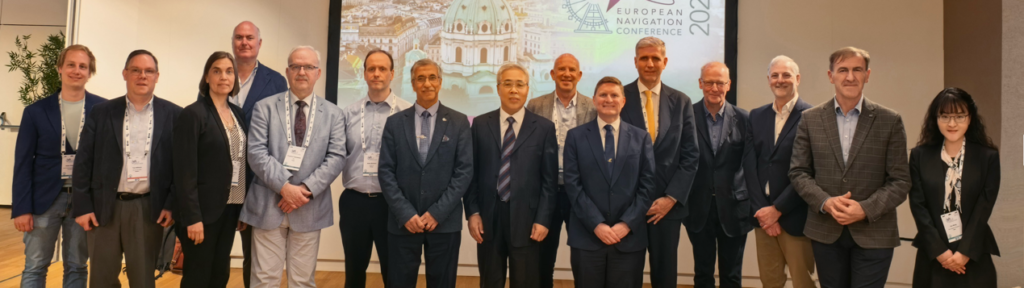
Group photo of participants at the 2026 IAIN Officers’ Meeting
On 27 April, the International Association of Institutes of Navigation (IAIN) held its Officers’ Meeting in Vienna, Austria. The meeting was chaired by IAIN President Prof. Zhang Baochen. Attending the meeting were all officers including the Senior Vice President, Vice Presidents, Secretary General, and Treasurer, as well as IAIN representatives to the International Maritime Organization (IMO), International Civil Aviation Organization (ICAO), International Association of Marine Aids to Navigation and Lighthouse Authorities (IALA), International Hydrographic Organization (IHO), International Committee on Global Navigation Satellite Systems (ICG), International Telecommunication Union (ITU), and the US Positioning, Navigation and Timing Advisory Board (US PNT). Observers from navigation institutes of China, the United Kingdom, Italy,Poland, and the United States also participated.
The meeting received reports on the 2025 financial accounts and the 2026 financial status, the recent activities of IAIN representatives to international organizations, progress on the preparations for the 2027 and 2030 IAIN World Congresses, and the maintenance and operation of the IAIN website. The meeting reviewed and approved the composition of the new IAIN Awards Committee, the formation plan and annual work programme of the Technical Committee. Discussions were held on preparations for the next Officers’ transition next year. It was decided to immediately initiate the nomination process for the next term of Officers, the nomination of rotating members of the Technical Committee, and a consultation on the Technical Committee’s operating rules. The formation of the Technical Committee and the review of IAIN’s first technical standard are to be completed within the year.
The meeting highly commended the achievements made since the previous Officers’ Meeting, including in the participation in intergovernmental international organizations affairs, the establishment and drafting of operating rules for the Technical Committee, the formation of the Awards Committee, the development of a terminology standard for autonomous ships, and the content maintenance and operation of the IAIN website.
It was decided that a second Officers’ Meeting and the first meeting of the Technical Committee will be held within the year.
IMO Seeks Heroes: Nominations Open for Exceptional Bravery Award
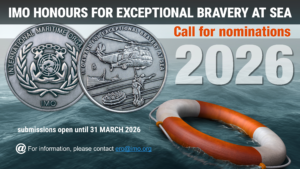
IMO is currently accepting nominations for exceptional acts of bravery performed at sea during the period 1 March 2025 to 28 February 2026. Nominations may also involve displays of extraordinary seamanship skills in very difficult conditions or any other acts of outstanding courage at sea. The nomination form can be submitted by any IMO Member State, intergovernmental organization in cooperation with IMO and non-governmental organization in consultative status with IMO. Please note the deadline for submission is 31 March 2026. Further information, including the Guidelines and the nomination form in Word format, can be found in the links below in the three working languages of the Organization:
Background information
Following the Council’s decision, at its 125th session, the Guidelines for the IMO Award for Exceptional Bravery at Sea were revised to reflect the establishment of the three categories of honour: the Award, Certificates of Commendation and Letters of Commendation. Subsequently, the Council approved the revised Guidelines at its 127th session in July 2022 and, as a result, the name of the scheme became the “IMO Honours for Exceptional Bravery at Sea”.
The honours are awarded annually and were established by the Organization to provide international recognition for those who, at the risk of losing their own life, perform acts of exceptional bravery, displaying outstanding courage in attempting to save life at sea or in attempting to prevent or mitigate damage to the marine environment. Such acts of bravery may also involve extraordinary seamanship skills in very difficult conditions or any other display of outstanding courage.
Nominations are scrutinized by an Assessment Panel made up of members of non-governmental organizations in consultative status with IMO, under the Chairship of the Secretary-General or his nominee. Subsequently, a Panel of Judges meets (under the Chairship of the Chair of the Council, with the participation of the Chairs of the Maritime Safety Committee, Marine Environment Protection Committee, the Legal Committee, the Technical Co-operation Committee and the Facilitation Committee) to consider the recommendations of the Assessment Panel and to select the recipient of the Award.
The recipients of the Award and Certificates of Commendation will be invited to attend the IMO Awards Ceremony to receive their accolades in person. Recipients of Letters of Commendation may also attend the ceremony, if they wish – however, their letters will be posted to the nominating authorities, which will be responsible for forwarding/presenting the accolade to the recipients.
Read more at the IMO’s official announcement:
https://www.imo.org/en/ourwork/ero/pages/imohonoursexceptionalbravery.aspx
IAIN Plans to Establish Technical Committee on Maritime Autonomous Surface Ships
In response to the growing need for standardization arising from the rapid global development of Maritime Autonomous Surface Ships (MASS) technology, the IAIN convened an online thematic meeting on June 4, 2025. The meeting, held pursuant to a decision made by the Officers’ Committee on May 20, 2025, focused on the establishment of a technical committee for standards. IAIN President Zhang Baochen, Senior Vice President Salvatore Gaglione , and Secretary General Hesham Helaljointly attended the meeting.
In recent years, driven by the International Maritime Organization (IMO), numerous countries and regions, including several EU member states, the United Kingdom, Russia, Japan, South Korea, and China, have intensified their research, development, and experimentation with MASS. Autonomous technology is increasingly becoming a major trend in the evolution of maritime navigation. By reducing human intervention, this technology holds the potential to mitigate crew shortages and lower risks to maritime safety, presenting broad application prospects. However, MASS operation heavily relies on modern communication, navigation, sensing, and artificial intelligence technologies, placing higher demands on the supply of navigational information. This is particularly critical in congested waters, where instantaneous, accurate, and highly reliable environmental perception and decision support are essential. Concurrently, a lack of unified technical standards persists in areas such as environmental perception, information processing, situational awareness, and collision avoidance decision-making. The prolonged absence of such standards could not only lead to duplicated research and development efforts but also pose potential threats to navigation safety and efficiency.
At the level of international maritime governance, the IMO is currently drafting the MASS Code, which is expected to be implemented voluntarily in 2028 and become mandatory in 2032. The current draft Code primarily outlines functional requirements and does not yet address specific technical standards. Following the proceedings at the IMO on behalf of its member institutes, and in accordance with its constitutional aim “to establish technical committees to study specific issues and formulate appropriate recommendations and standards,” IAIN has decided to establish a technical committee for standards. Its initial primary focus will be on MASS technology, aiming to foster technological development, enhance cooperation, and support international maritime governance.
During the meeting, consensus was reached regarding the committee’s organizational structure. The committee will comprise seven members: three standing members (the President, Senior Vice President, and Secretary General for the 2025-2027 term), and four rotating members nominated annually by IAIN Member Institutes. Zhang Baochen will serve as the inaugural Chair. The nomination process for the rotating members will commence shortly. The nominated candidates will be reviewed by the three standing members before being submitted to the Officers’ Committee for final confirmation.
The meeting also proposed the establishment of a Secretariat for the committee. The inaugural Secretariat will be located in China, with support provided on a voluntary basis by personnel seconded from member units of the China Institute of Navigation. To ensure operational continuity and global representation, the Secretariat’s location will rotate in the future, aligning with the institution of the Chair.
Regarding the work plan, the Chair will take the lead in drafting the committee’s rules of procedure, defining its scope, responsibilities, meeting protocols, and decision-making mechanisms. The committee’s inaugural standardization project will focus on “terminology for autonomous ships.” The draft standard is planned for completion in 2026, after which it will enter a consultation period. Following the consultation, the list of nominated members, the rules of procedure, and the first standard will be submitted for review at the 2026 Officers’ Committee meeting as soon as possible. According to the plan, the committee will convene its inaugural meeting immediately after the Officers’ meeting. Subsequently, all committee meetings will be scheduled in conjunction with IAIN Officers’ Committee meetings to enhance efficiency.
In the near term, the committee will focus on studying core technical issues in the field of autonomous navigation, organizing research and deliberation on standards, and preparing IAIN to provide expert advice to the IMO and other relevant international organizations in a timely manner. The convening of this preparatory meeting marks a substantive step by IAIN in the global effort to collaboratively establish technical standards for MASS, demonstrating a proactive commitment to addressing technological change and advancing industry standards.
Speech at the Closing Ceremony of the IAIN World Congress 2024 Zhang Baochen, President of IAIN
Distinguished guests, ladies and gentlemen, friends from the media,
Good afternoon!
I am honored to serve as the new President of the International Association of Institutes of Navigation (IAIN). This is both an encouragement for my personal career and service to the international community, as well as a new challenge for me. I would like to thank all members of the Officers’ Committee for their support, thank all IAIN member institutes for their trust, and of course, thank the China Institute of Navigation (CIN), especially President He Jianzhong, for nominating me to join the previous Officers’ Committee three years ago, where I was appointed IAIN Senior Vice-President.
Over the past three years, I have developed deep friendships and mutual trust with my predecessor, Mr. Krzysztof Czaplewski, and all other members of the Officers’ Committee. It should be emphasized that IAIN has a long history. The wise leadership of successive Presidents such as Krzysztof Czaplewski and John Pottle, Secretaries General such as Hesham Helal and Simon Gaskin, and other Officers has ensured the operation and steady development of IAIN in accordance with its Constitution. I would like to take this opportunity to express my deep gratitude and high respect to all of them.
Now begins the new term of the IAIN Officers’ Committee. This concerns not only how we can work together with all members to achieve good performance for IAIN over the next three years, but also how we can ensure that IAIN moves toward a brighter future and better fulfills the aims of our association.
This is a fundamental question that I, and every Officer, should consider. I believe that we will listen to everyone’s views, reach consensus, and provide our answer as soon as possible. In this process, we will keep in mind the need to listen as much as possible to voices from different parts of the world and to represent as wide a range of interests as possible.
I hope that from now on, we can prioritize improving our ability to fulfill IAIN’s purposes and functions, commit to accelerating the expansion of our membership and broad participation in the association’s activities, strive to enhance the appeal of navigation technology to young professionals in the field, and endeavor to strengthen our presence and contributions.
We know that navigation technology is not only ubiquitous in today’s world, but it is also showing an accelerated trend of integration with new and rapidly advancing technologies such as artificial intelligence.
Taking the development and application of autonomous ship navigation technology as an example, the rapid progress in both technological development and application calls for a deeper, more diverse, and broader platform and vehicle for exchange and cooperation, as well as a more convenient, reliable, and standardized support mechanism and channel that meets integrated needs.
I know that there may be many difficulties and challenges, but if these are the directions and priorities defined by IAIN’s Constitution, then we have every reason to work hard toward them.
Officers, representatives of member institutes, experts and scholars, ladies and gentlemen, as the new President of IAIN, I will carry out my duties with enthusiasm and responsibility, and work together with other Officers to make positive efforts in serving our members and advancing IAIN itself.
The IAIN World Congress 2024 is now coming to an end. As one of the organizers of the Congress, I would like to thank the previous Officers’ Committee for its leadership and full support and cooperation with me and the Congress, thank all member institutes and experts for their participation and selfless contributions, thank all participants for being the protagonists of the Congress, and thank CIN and all supporting institutions and personnel involved in organizing and servicing the Congress. Thank you all for your understanding and tolerance regarding any shortcomings in our work.
Now, let us look forward to the next World Congress in Krakow, Poland.
Thank you all!
IAIN World Congress 2024 Concludes in Beijing
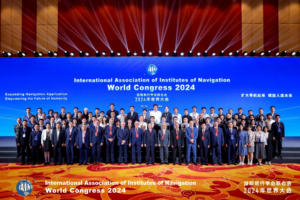
Group Photo at the IAIN 2024 World Congress Closing Ceremony
On October 30th, the two-day IAIN World Congress 2024 concluded in Beijing. Experts and delegates engaged in in-depth exchanges and discussions around the theme “Expanding Navigation Applications, Empowering the Future of Humanity.”They shared the latest research achievements in the field of navigation and maritime technology and explored the possibilities for the future development of navigation applications.
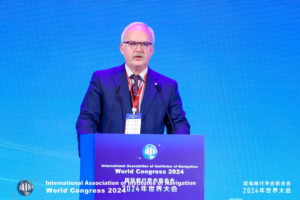
17th IAIN President Christopher Czaplewski presiding over the closing ceremony
At the closing ceremony, Christopher Czaplewski, the 17th President of IAIN, announced the composition of the new Officers’ Committee. Zhang Baochen, Executive President of the China Institute of Navigation, was elected as the 18th President of IAIN. The other members of the Officers’ Committee include: Senior Vice-President Salvatore Gaglione (IIN), Vice-President Bart Banning (NIN), Vice-President Thomas Southall (RIN), Secretary General Hesham Helal (AIN), Treasurer Tom Willems (NIN), and Immediate Past-President Krzysztof Czaplewski (PNF), all serving until 2027.
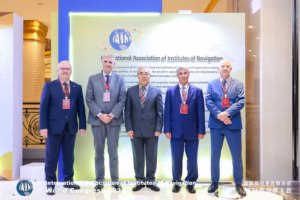
Group photo of the newly elected IAIN Executive Committee members attending in person
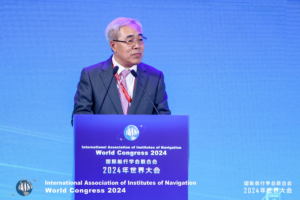
18th IAIN President Zhang Baochen delivering a speech
During the closing ceremony, Zhang Baochen stated that the new IAIN officers will focus on enhancing IAIN’s ability to fulfill its mission and role, continuously expand the breadth and participation of academic exchange activities. As navigation technology accelerates its integration with new technologies like artificial intelligence, the new IAIN officers will collaborate with all members to establish diverse and extensive exchange and cooperation platforms, creating a more convenient, reliable, and integrated standardization working mechanism.
On Oct.28, the Officers’ Meeting and the General Assembly were held. The Officers’ Meeting reviewed and approved the financial report, ratified the IAIN awards for 2024, including conferring Honorary Membership upon John Pottle and Simon Gaskin, and confirmed the officers for 2024-2027. The General Assembly, held in a hybrid format, formally approved the award results.
During the Congress, over 40 Chinese and international paper authors presented their work in four parallel sessions. Following the IAIN paper evaluation mechanism, and based on a comprehensive assessment by expert judges considering innovation, scientific rigor, practicality, as well as the presenter’s delivery, content depth, and influence, the paper titled “Positioning Method Based on Radar Reference Targets in GNSS-Denied Maritime Environments” by Chinese authors Sun Shuai, Lyu Hongguang, Yang Xiao, and Yang Yang was awarded the prestigious “Sadek Award” for the best paper of the Congress.
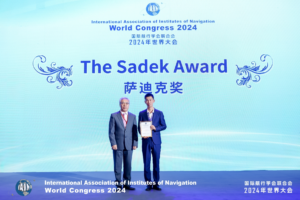
IAIN President Zhang Baochen presenting the Sadek Award to the winner Sun Shuai
The closing ceremony also announced that the next IAIN World Congress will be held in Krakow, Poland, in 2027. Janusz Uriasz, Chairman of the Polish Navigation Forum, provided an overview of the host city and preliminary preparations for the next Congress.
Profile of Zhang Baochen
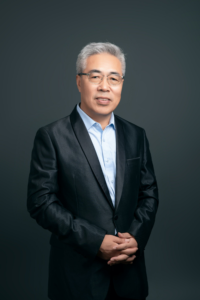
The newly elected 18th President of IAIN, is a Professor,Senior Engineer and Chief Expert of China Waterborne Transport Research Institute. He also serves as Executive President of the China Institute of Navigation , and Deputy Director of the Technical Cooperation Committee of National Key Laboratory of Waterway Traffic Control.
Born in 1960, he obtained his bachelor’s degree in navigation from Dalian Maritime University and his master’s degree in Transportation Information Engineering and Control. He has long been engaged in the research and development, engineering application and industry promotion of traffic safety and intelligent shipping technologies.
He has presided over 3 national-level scientific and technological research projects including Key Technologies for Ship Intelligent Navigation and Control Based on Ship-Shore Collaboration, and many ministerial-level projects such as Prevention and Control of Extra-Huge Safety Risks in Ports and Shipping Based on Typical Cases, Industrial and Technological Development Roadmap of Intelligent Shipping, and Safety Supervision and Service Guarantee System for Intelligent Shipping. He has published many papers, been granted more than 20 invention patents, and authored monographs including Ship Intelligent Navigation Technology, Unveiling Intelligent Shipping and ISM Code and Its Implementation.
He has won 3 Grand Prizes and 4 First Prizes of the Science and Technology Award of the China Institute of Navigation, and 1 First Prize of Qingdao Science and Technology Progress Award.
He has successively served as Director of the Safety Committee Office of the Ministry of Transport, Deputy Director-general of Zhejiang Maritime Safety Administration, Director-general of Shandong/ Tianjin Maritime Safety Administration, President and Academic Committee Director of China Waterborne Transport Research Institute, etc.
IAIN World Congress 2024 Opens in Beijing
On Oct.29, the International Association of Institutes of Navigation (IAIN) World Congress 2024 commenced this morning in Beijing, with its Opening Ceremony and Plenary Session drawing over 300 participants from across the globe. Held under the theme “Expanding Navigation Applications, Empowering the Future of Humanity,” the Congress is hosted by the China Institute of Navigation (CIN) and focuses on advances in satellite navigation and related technologies.
Attendees included IAIN member representatives, researchers, academics, and industry experts from the United States, the United Kingdom, Italy, the Netherlands, Sweden, Poland, Egypt, Japan, South Korea, China, and other countries. The program features keynote speeches, technical paper presentations, and exhibitions aimed at exploring integrated applications of navigation, communications, remote sensing, and emerging technologies.
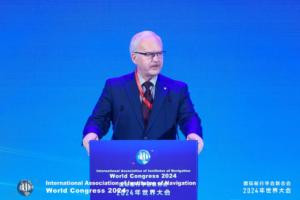
IAIN President Krzysztof Czaplewski addressed the congress
Discussions during the opening highlighted several forward-looking trends in navigation technology, including intelligent systems, high-precision positioning, multi-modal interaction, and integration with autonomous driving. These developments are expected to enable more accurate guidance, personalized services, and new models of production and daily life.
The Congress continues with technical sessions and dialogues on standardization, sustainability, education, and cross-sector collaboration, serving as a platform for global experts to share insights and strengthen cooperation in the field of navigation.
At the opening ceremony, the International Association of Institutes of Navigation (IAIN) presented several prestigious awards, including the John Harrison Award for Lifetime Achievement, the Necho Award for Special Achievement, and the Honorary Membership Award. Chinese global circumnavigator Zhai Mo was honored with the Necho Award, becoming the first Chinese recipient of this distinction. The John Harrison Award was conferred upon Dana Goward, President of the U.S. Resilient Navigation and Timing (RNT) Foundation, while former IAIN President John Pottle and former Secretary-General Simon Gaskin received Honorary Membership Awards.
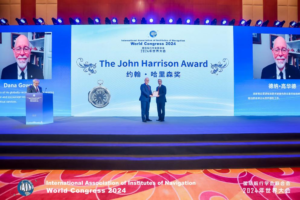
The John Harrison Award(The awardee is Dana Goward, who accepted the award online, and Hesham Helal accepted the award on-site on his behalf.)
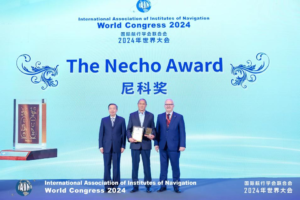
The Necho Award(Awardee: Zhai Mo)
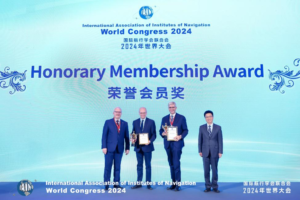
Honorary Membership(The awardees are John Pottle and Simon Gaskin, with the award accepted on Mr. Gaskin’s behalf by Salvatore Gaglione)
Following the awards presentation, the Plenary Session featured a series of compelling keynote speeches from world-renowned navigation experts. These addresses delved into the most pressing topics and cutting-edge developments in the field, from the architecture of major satellite navigation systems like Beidou to the future of autonomous shipping and aircraft navigation. The distinguished lineup of speakers underscored the congress’s role as a premier global forum for sharing knowledge and fostering international collaboration to shape the future of navigation technology for the benefit of humanity.
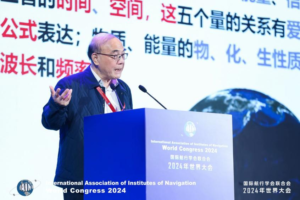
Liu Jingnan, Academician of the Chinese Academy of Engineering and Director of National Engineering Research Center for Satellite Positioning System, delivered a keynote speech on “Beidou Satellite Navigation System and Its Applications”.
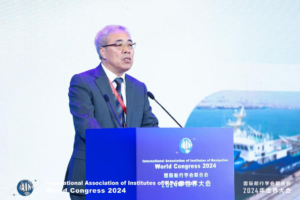
ZHANG Baochen, Senior Vice-President of IAIN and Chinese autonomous navigation expert, delivered a keynote speech on “MASS and Navigation”.
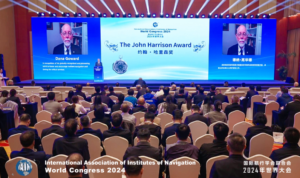
Dana Goward, President of the U.S. Resilient Navigation and Timing Foundation, delivered a keynote speech on “Cooperation and Conflict Building Tomorrow’s Navigation to Bring the World Together” (via remote participation).
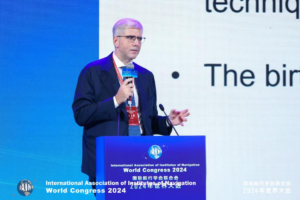
Salvatore Gaglione, Vice President of IAIN, delivered a keynote speech on “Latest Developments in Navigation Technology Application”.
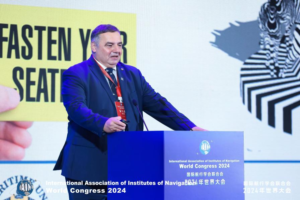
Adam Weintrit, Rector of Gdynia Maritime University, Poland, delivered a keynote speech on “A Balanced Reaction of the Maritime Education Sector to Marine Technology Development including Autonomous Surface Shipping”.
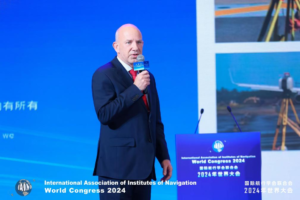
Bart Banning, Vice President of IAIN and President of the Netherlands Institute of Navigation, delivered a keynote speech on “The Transition of Aircraft Navigation Towards a Global True North System”.
The IAIN World Congress 2024, running through October 30, stands as a testament to the power of global cooperation in advancing navigation science and technology. By bringing together the world’s leading minds under the theme “Expanding Navigation Application, Empowering the Future of Humanity,” the event not only showcases breakthrough innovations but also fosters the cross-sector partnerships necessary to address tomorrow’s challenges. As navigation technologies increasingly underpin autonomous systems, intelligent transportation, and everyday life, the outcomes of this congress will resonate far beyond Beijing, shaping the future of how humanity moves across sea, air, land, and space.