Industry pays tribute to Alert!
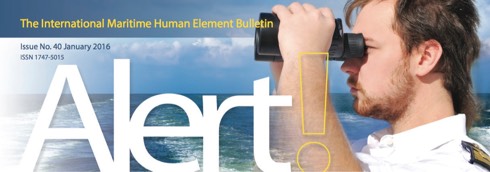
Just over twelve years ago The Nautical Institute launched its international human element bulletin, Alert! The first issue came out in October 2003, as seafarers were getting to grips with new technology and automation. It was becoming clear that more attention needed to be paid to human-centred design and human factors engineering as well as seafarer training.
Since 2003, there has been a transformation in the industry’s understanding of the human element in ship design, construction, management and operation. The journal Alert! has played its part in that sea change.
Former Lloyd’s Register CEO Richard Sadler noted: ‘Every article in every issue over the years has dealt with the fundamentals of the human factor and increased the awareness of every reader. I am sure we could find evidence that this publication has directly or indirectly saved lives and accidents.’
Alert! #40 is available here.
Hidden histories of the information age
Hidden Histories of the Information Age is a series of short radio programmes available on BBC Radio 4.
Today’s 15-minute programme, the fifth out of five, tells the story of how GPS helped navigation in the first Gulf War (1990 – 1991).
This link will take you to the BBC to listen to it.
This link will take you to the series web page where you can find the other four programmes as well, and this link will allow you to download it.
The programme should be available for 28 days.
IMO – a message from the Secretary General


Mr Kitack Lim was elected Secretary-General of the Organization by the 114th session of the IMO Council in June 2015 for a four-year period beginning 1 January 2016. The election was endorsed by IMO’s Assembly at its 29th session in November 2015. Kitack Lim (Republic of Korea) is the eighth elected Secretary-General of the International Maritime Organization.
We reproduce here by kind courtesy the new IMO Secretary-General’s message
Enduring eye: the Antarctic legacy of Sir Ernest Shackleton and Frank Hurley
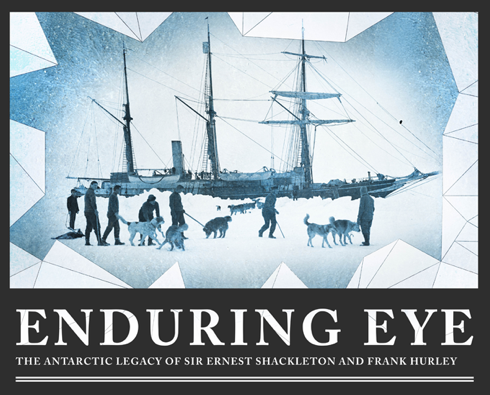
One of the greatest photographic records of human survival has gone on display in a remarkable new exhibition at the Royal Geographical Society (with IBG) in London. Running to 28 February 2016 this exhibition honours the achievements of Sir Ernest Shackleton and the men of the Endurance Expedition of 1914-1917. Newly digitised images reveal previously unseen details of the crew’s epic struggle for survival both before and after their ship was destroyed.
eLoran timing and data signals from the U.K.
News was received from Taviga (a new collaboration derived from Timing and Navigation) on 7 January that low frequency eLoran transmissions from Anthorn in Cumbria (UK) will continue despite the switch off of the legacy Loran-C transmissions by the French, Norwegian, Danish, and German transmitters. Signals from the Russian Loran-C equivalent – Chayka – are still available, it is understood.
All European Loran-C stations except Anthorn ceased at 1100 on 31 December 2015.
Taviga’s press release of 7 January 2016 is available here.
China Institute of Navigation – Change of Board of Directors
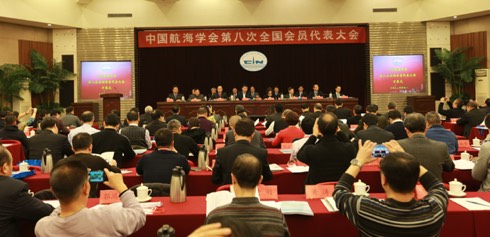
The 8th National Member Conference of the China Institute of Navigation (CIN) was held in Beijing on 12 December last.
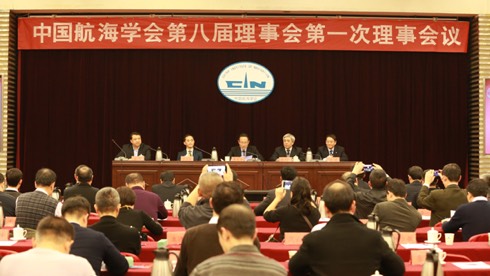
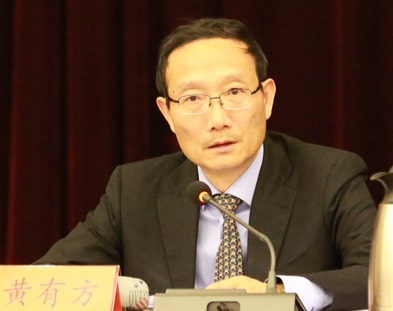
The working report and financial report of the 7th Board of Directors were published at the Conference. The 8th Board of Directors was selected at the same time. President of Shanghai Maritime University, Professor HUANG Youfang, was selected as the chairman. Mr YU Shicheng, (Guangzhou Salvage Bureau, Ministry of Transportation), was selected as the Executive Vicechairman. Mr WANG Qun, (Rescue & Salvage Bureau, Ministry of Transportation), was selected as the Secretary General.
The international workshop on Tsunami Inundation Mapping (TIM)

On 25/26 November 2015 a training course was organised by the Hydrographic and Oceanographic Department of the Japan Coast Guard (JHOD). This was achieved with the assistance of the Intergovernmental Oceanographic Commission (IOC); the International Hydrographic Organization (IHO) and the Port and Airport Research Institute (PARI). The event was held in JHOD’s office in Tokyo.
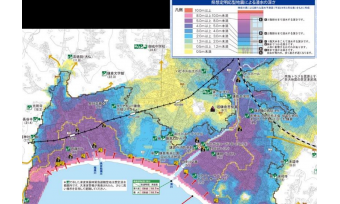
According to Japan Coast Guard this was the first time such a workshop had been held among Hydrographic Offices in the East Asia region. The objective of the workshop was to improve capacity of Hydrographic Offices mainly in the East Asia countries for development and utilization of the tsunami inundation map (illustrated). They then went on to discuss the way forward to realize this
understanding, through lectures given by researchers from Tohoku University, PARI, and others sharing experiences or challenges.