
IFALPA and Madrid
On 7th August 2012 the International Federation of Air Line Pilots’ Associations (IFALPA) issued a statement outlining forthcoming important operational runway designations at Madrid-Barajas (LEMD) airport.
On behalf of Sindicato Español de Pilotos de Líneas Aéreas (SEPLA), the Spanish Air Line Pilots’ Association, IFALPA has issued a notification of these changes and a copy is to be found in this pdf reproduced by kind permission of IFALPA.
ICS on IMO action
The International Chamber of Shipping (ICS), which represents global shipowners and 80% of the world merchant fleet, has welcomed the decision by the IMO Sub-Committee on Safety of Navigation (held from 2nd to 6th July in London) to take action to address operating anomalies with ECDIS, and to reject a proposal to establish a new recommended route for all ships in the Mozambique Channel that
would have been approximately 1,000 miles long.
Pilots and shipowners on pilot ladder safety
With its base in HQS Wellington on the Thames the International Maritime Pilots’ Association (IMPA) is a professional, non-profit making body, primarily concerned with promoting professional standards of pilotage worldwide in the interests of pilots’ safety. It has some 8,000 members in over 40 countries. IMPA seeks to achieve its principal objective, the promotion of professionally sound and
safe pilotage.
Another London-based organisation is the International Chamber of Shipping (ICS), the principal international trade association for shipowners, with a membership comprising national shipowners’ associations from 36 countries, representing over 80% of the world merchant fleet, in all sectors and trades.
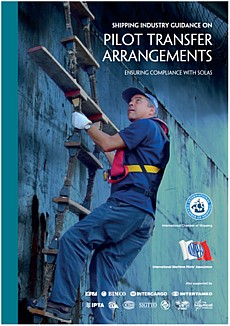
It was reported on 26th July that IMPA and the ICS have joined forces to update a brochure aimed at shipping companies and seafarers, reminding them of the vital need to ensure that ladders used for pilot transfers are safe and always rigged correctly.
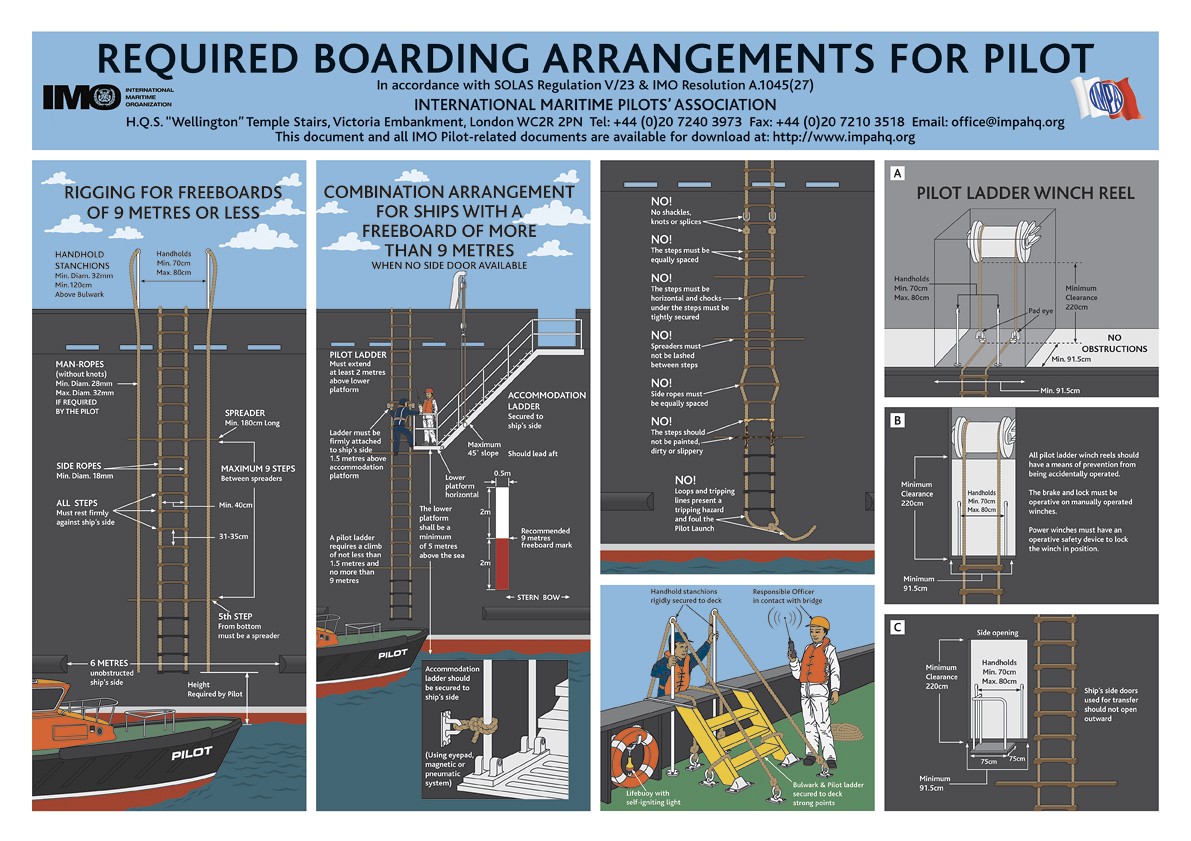
Poster available as pdf
Breakdown of separation
On 31st July the Australian Transport Safety Bureau (ATSB) issued a report into an aviation incident the previous October. At 1500:51 Eastern Daylight-saving Time on 8th October 2011, a breakdown of separation (BOS) occurred 59 km north-east of Armidale, New South Wales between a Boeing 737-8FE (737), registered VHYVA, and a Gulfstream IV (G-IV), registered VH-CGF. VH-YVA was flying Brisbane to Sydney and VH-CGF was en route from Melbourne to Coolangatta, Queensland.
SAAB and 5th generation AIS
At the end of June the defence and security company Saab announced that the company’s advanced fifth-generation R5 family of AIS products were now commercially available.
Said Stefan Karlsson, Vice President Sales and Marketing, Saab TransponderTech., “The new R5 AIS products from Saab are the first to incorporate software-defined radio (SDR) transceivers together with newly developed high-speed analog-to-digital converters in a type approved Class A system. The result is a dramatic improvement in receiver sensitivity, stability and signal processing compared to our already exceptional R4 platform.”
US NTSB assists Nigerian government
It was announced from Washington on 6th June that the National Transportation Safety Board (NTSB) is dispatching an investigator to assist the Government of
Nigeria in its investigation into the crash of a Dana Air Boeing MD-83 airplane,
Flight #0992.
On 3rd June at about 1151 local time, the airplane, en route from Abuja to Lagos, Nigeria, crashed outside the airport into a two storey building. All 153 passengers and crew onboard were fatally injured, and an undetermined number of ground fatalities and injuries also occurred.
US NTSB safety recommendation
It was announced from Washington DC on 24th May that the US National Transportation Safety Board made three new safety recommendations to the US Coast Guard, known as M-12-1, M-12-2 and M-12-3.
Amateur built aircraft crashes
A National Transportation Safety Board (NTSB) study found that in 2011 ten of 102 experimental amateur-built (E-AB) aircraft built by their owner crashed on their first flight. And 14 of 125 aircraft that had been bought used crashed on the new owner’s first flight.
The study, which was launched last year, evaluated all E-AB accidents that occurred in 2011. The data show that powerplant failures and loss of control in flight are the most common accident occurrences by a large margin, highlighting the importance of pilots having the information and training necessary to safely operate their aircraft.
Olympics security airspace restrictions
The UK Civil Aviation Authority has confirmed the enforcement policy that will
be in place to deal with infringements of this summer’s Olympics security airspace restrictions.
The existing CAA policy of not generally pursuing a prosecution in cases when an airspace infringement is inadvertent, and the pilot has taken all reasonable steps to resolve the situation safely, will remain. However, as infringements of the security airspace are likely to have a significant impact on other airspace users, the licences of all pilots infringing either the Restricted or Prohibited Zone will be suspended pending an investigation of the incident.
Improved passenger and cargo security
States from across the Middle East agreed in April on collective action to improve passenger and cargo security throughout the region, as part of a global initiative to counter threats to civil aviation worldwide.
Participants underscored the need to work more closely together in response to threats and incidents, and stressed that ICAO must continue to address, as a matter of priority, threats to the global air cargo system by enhancing supply chain security.
Eurocontrol’s five millionth flight
Early in May EUROCONTROL’s Maastricht Upper Area Control Centre (MUAC) controlled its five millionth flight – KLM 577 from Amsterdam to Abuja, Nigeria – with its trajectory-based flight data processing system (FDPS), introduced in December 2008. The crew were informed of this milestone in the use of MUAC’s state-of-the-art technology which allows it to control over 5000 flights on a busy
day.
NATS appoints defence department head
UK’s National Air Traffic Service has appointed Commander Ewan Kelbie to head up its defence strategy department, developing products for the military market in the UK and abroad.
US National Safe Boating Week
NOAA’s National Weather Service and the National Safe Boating Council (NSBC) have again come together to encourage recreational boaters to know their risks, learn the rules, and be prepared before taking the helm this summer during National Safe Boating Week from 19th to 25th May.
According to the US Coast Guard, there were more than 4000 boating accidents,
including 758 deaths, in 2011. 70% of all fatal boating accident victims drowned, and of those, 84% were reported as not wearing a life jacket. Once in the water hypothermia can become a significant threat to survival even if wearing a life jacket.
Minutes of the IAIN Officers’ meeting, April 24, 2012
A meeting of the IAIN Officers took place at 1500 on 24 Apr 12 in the Polish Baltic Philharmonic, Gdansk – prior to ENC 2012.
Report to the IAIN Officers’ meeting on IHO
IAIN participates to IHO conferences, which should become the Assembly when the new IHO convention is ratified1. IHO is an independent organization having the status of observer in UN and comprising 84 member states.
Report on ICAO Activity in 2011
Air safety, Sustainable development of the industry and the environment remain ICAO priorities.
Report on the p&o meeting for the 7th Meeting of the International Committee on GNSS (ICG)
IAIN was represented by Elisabeth Fischer (OVN), participants: China, the European Space Agency, the European Union, India, Italy, Japan, Nigeria, the Russian Federation, the United Arab Emirates, the United States of America, the Bureau international des poids et measures (BIPM), the International Association of Institutes of Navigation (IAIN), the Civil GPS Service Interface Committee (CGSIC), the United Nations Office for Outer Space Affairs (UNOOSA), the Space Generation Advisory Council (SGAC)
IMO Report to IAIN Officers, April 24, 2012
Relatively little time has passed since our last meeting in London. The next MSC meeting is to be held in May. The items mentioned in my previous as being sent forward to MSC for approval have thereby not yet met with such approval. This report therefore focuses on the next session of NAV that is the 58th meeting of the Sub Committee of Navigation (NAV 58) to be held from 2nd till 6th of July in London at IMO’s headquarters under the chairmanship of Mr Mike Sollosi (USA).
PNT Ninth Meeting Report, November 9-10, 2011
Space-Based PNT Advisory Board Meeting on November 2011, was held prior to the IAIN officers’ meeting in London 23 of November where the undersigned has presented an oral report to the honorable IAIN member. However, the full comprehensive report of the meeting is published on the PNT site.
NTSB general aviation safety forum
On 7th May it was announced by the National Transportation Safety Board (NTSB) that it will hold a two-day forum on 19th and 20th June in Washington DC where will be discussed safety issues related to general aviation.
Commented Chairman Hersman, “Each year, hundreds of people are killed in general aviation crashes, and thousands more are injured. Tragically, the circumstances leading to these accidents are often repeated over and over, year after year. If we are going to prevent future fatalities and injuries, these common causes must be addressed.”
Galileo’s first payload ready
ESA announced on 19th April that the next Galileo navigation payload has been completed and is on its way to meet the satellite platform that will host it in orbit. The first of 14 Galileo Full Operational Capability (FOC) navigation payloads has been shipped from Surrey Satellite Technology Ltd in the UK to prime contractor OHB System AG in Bremen Germany.
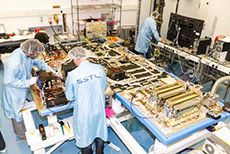
These payload panels for the first Galileo Full Operational Capability satellite are undergoing final testing in the Assembly Integration Test hall at Surrey Satellite Technology Ltd in Guildford, UK, in April 2012 before being boxed up for shipment to prime contractor OHB in Germany. – Credits: SSTL 2012
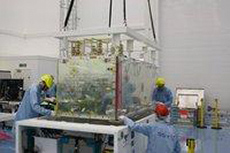
The first Galileo Full Operational Capability flight model payload with its solar panels in their ‘boxed’ position, being lifted by crane into its shipping container at Surrey Satellite Technology Ltd in Guildford, UK in April 2012. This is the first of 14 Galileo FOC payloads to be transported to prime contractor OHB in Germany for integration with their satellite platforms. – Credits: SSTL 2012
The payload, the part of the satellite that provides Galileo’s precision
positioning measurements and services to users worldwide, will then be added to its waiting satellite platform.

The Search and Rescue antenna on the first Galileo Full Operational Capability satellite payload to be completed, at SSTL in the UK before its shipment to OHB in Germany. This antenna will pick up distress calls from around the globe and relay them to local authorities, as well as sending a notification back to those awaiting rescue, operating as part of the international Cospas-Sarsat system. – Credits: SSTL 2012
ENVISAT services interrupted
After ten years of service, Envisat has stopped sending data to Earth. ESA’s mission control is working to re-establish contact with the satellite,
and made this announcement on 14th April. Although this landmark
mission has been in orbit twice as long as it was designed for, ESA hopes
to keep the satellite in service until the launch of the successor Sentinel
missions.
Titanic’s legacy reaches space

World’s busiest ice-covered sea – image courtesy of ESA
A century ago, RMS Titanic struck an iceberg while crossing the North Atlantic and sank at the cost of over 1500 passengers and crew. Today, thousands of vessels cross the same iceberg-ridden path with no loss of life – and satellites are helping.
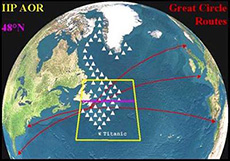
The International Ice Patrol area of operation. This view of the North Atlantic and surrounding continents displays the International Ice Patrol’s Area Of Operations (AOR) in yellow from 40°N to 50°N, and 39°W to 57°W. The 48°N latitude line is drawn in purple within the Ice Patrol AOR. The transatlantic shipping lanes from Europe to North America are in red. Typical iceberg paths and distribution within the AOR are represented by numerous white triangles along the 200 m bathymetry from Greenland to the Grand Banks of Newfoundland. The position of the 1912 Titanic sinking is represented by a white asterisk at the tail of Grand Banks near the bottom of the Ice Patrol AOR. – image courtesy of IIP
IFALPA supports ICAO Dangerous Goods Panel
In mid-February the International Federation of Air Line Pilots’
Associations (IFALPA) saluted the work of the Dangerous Goods Panel
of the International Civil Aviation Organization (ICAO) in advancing new
safety standards for the transport of lithium battery consignments.
ISO certification of ICAO Technical Co-operation Bureau
It was announce by ICAO in March that it had been certified to ISO 9001:2008
standard for quality management systems.